Showing posts with label sin. Show all posts

Sunday, March 7, 2021

Technology and the Deadly Sin of Sloth: Part 1

Emily had worked hard to make it to her senior year. majoring in engineering, she was usually hitting the books until late into the evening while her roommate was watching a movie or hanging out with friends. Her hard work paid off: she got good grades, earning a GPA high enough to keep her scholarship. The senior design project course was a final rite of passage, but not for the reasons she first expected. She knew it would require buckling down even more to produce an innovative design that built on what she had learned. She knew that she would expect as much or more from herself as her professors expected.  What she did not anticipate was the difficulty of working with a teammate who did not pull their own weight. She had seen Matt in some of her courses, but he didn’t seem to take them seriously enough. Somehow he still passed and made it to his senior year. They were assigned to the same team in the first week of the design course, along with two other students. They all dove into the work and contributed the blood, sweat, and tears that would form a great design. Except Matt. He showed up late to team meetings --  if he showed at all. There was always an excuse, some urgent reason that kept him away or prevented him from getting his part done. What work he did contribute was hurried with little thought or work, and outcomes that were half-baked or painfully wrong, In a word, Matt was lazy. Like Tom Sawyer trying to get the neighborhood gang to paint the fence for him, Matt was always looking for an angle. He was forever seeking that magic shortcut that would get him the result without the effort. Matt repeatedly tried to convince the rest of the team that he was the big idea man, not the worker bee. He would claim his contribution was leadership and vision whose value could not be measured by effort alone. Emily wasn’t buying it. Matt wasn’t leading the team; rather, his idleness was weighing them down.


Merriam-Webster dictionary defines sloth as a “disinclination to action or labor.” Sloth is the sin of laziness. A lazy person does not pull their own weight. They doze off instead of dig in. They lollygag instead of labor. They do not take responsibility for their well-being, hoping others will take care of them. They do not contribute to the team, hoping teammates will cover their deficiencies. A lazy person does not take their turn. A slothful person does not do their fair share. 

One form of laziness is procrastination. If our delaying tactics result in avoiding legitimate responsibilities or dutiful work, whether intentional or not, it becomes the sin of sloth. “Sluggards do not plow in season; so at harvest time they look but find nothing.” (Proverbs 20:4)  In school, you might have had classmates who postponed studying until the night before the big exam. They would suddenly be in a panic, and the less scrupulous would devise ways to cheat, even asking those that studied to help them in their deceit. At work, you may have participated in a team where someone was constantly late finishing their part of the work. This either diluted the quality of the product or resulted in others having to put in extra time to cover the gaps.

A lazy person sometimes explains their disdain for work by claiming to be looking for shortcuts to be efficient. However, their true motivation is the avoidance of exertion. An addict to the lottery is looking for such a shortcut, hoping that a big payoff will mean they never need to work another day. Investors that get duped into a sure pay-off are similarly gambling under the guise of investment, willfully ignoring that something too good to be true probably isn’t. 

At first, it may be difficult to discern whether an engineer seeking a shortcut is optimizing the work or avoiding the work. I understand the drive to optimize. I often catch redundancy because I tend to notice patterns. I spot repetition and rhythm in visual images, poetry, episodes of a television show, and more. When I am writing software and I recognize I am writing something redundant, I tend to refactor my code to make it more efficient, avoiding duplication. When I notice I am repeatedly performing the same complex calculation, I build a script or spreadsheet to compute it for me. The challenge in deciding whether to automate (or not) is to balance the extra cost of creating the automation against the savings in labor. If it takes me an hour to write a script to save a few seconds on a calculation I will only perform a dozen times in total, I have wasted the effort. However, if it saves me minutes of time on thousands of calculations, my side effort has paid off handsomely. 

The pursuit of efficiency is a significant driver for technology development. Since efficiency is sometimes the excuse for laziness, it may be worthwhile to consider the connection of technology to the sin of sloth. We often pursue technology as a means of saving labor. A labor-saving instrument enables at least two options that take advantage of the savings: increased leisure or increased productivity. A lumberjack armed with an ax might cut down three trees in an hour, but armed with a chainsaw can cut down three trees in just a few minutes. The lumberjack could now choose to take much longer breaks or to cut down a larger number of trees. If I am that lumberjack, is my purpose and calling to take breaks? Is it to cut down as many trees as possible? Perhaps the labor savings can be used in some wiser manner? Perhaps I can now spend more time considering which trees are the best to cut down this season for the quality of their wood and the overall cultivation of the forest. Perhaps I can now spend more time considering safety for myself and my co-workers when I drop the next tree.

Another form of sloth occurs when we lose sight of priorities, spending an inordinate amount of time on an unimportant activity to the detriment of important work. This muddling of our priorities can happen when we stop paying attention and lose focus. Before we know it, we have spent an hour doom-scrolling through bad news or swiping past Facebook posts -- with no time left for the important task of the day. Muddling priorities can also be a more conscious choice. First, we may choose to misprioritize out of fear, because we have anxiety about the difficulty of the work we should be doing, so we simply avoid it. Second, we may choose to misprioritize for purely selfish reasons, putting ourselves above others, choosing pleasure, power, or other self-indulgences instead of fulfilling our duty.

If sloth is the avoidance of effort and this is sinful, then it seems the effort is something God desires us to pursue. Why? When receiving a gift that is not as lavish as some others, but that was given with sincerity, we sometimes say “It’s the thought that counts.” What we really meant is that the giver intentionally put effort into the gift. It is not solely the thought that counts -- it is the effort. When we strive toward a goal, we are working. Not all goals are good goals. To discern good work for ourselves, we must examine its purpose. 

The purpose of work 

A lazy person will sometimes actually work hard at avoiding work. Mark Twain immortalized this type of laziness in his descriptions of Tom Sawyer scheming to convince other people to whitewash Aunt Polly’s fence, thereby relieving him of the task. Do work and play have a legitimate purpose in day-to-day human life? Or is work a necessary evil to pay for our play? Considering his success at convincing others to whitewash the fence in his place, Tom mused about the nature of work. 

Work consists of whatever a body is obliged to do, and that Play consists of whatever a body is not obliged to do. And this would help him to understand why constructing artificial flowers or performing on a tread-mill is work, while rolling ten-pins or climbing Mont Blanc is only amusement. There are wealthy gentlemen in England who drive four-horse passenger-coaches twenty or thirty miles on a daily line, in the summer, because the privilege costs them considerable money; but if they were offered wages for the service, that would turn it into work and then they would resign.

Tom realized that work is in the eye of the beholder. However, Twain lures us into a false dichotomy by contrasting work with play, as if work was drudgery to be avoided and play was enjoyment to be pursued. 

I admit that I sometimes fall into this wrong thinking about work. But this is not the way it is supposed to be. From the beginning, Adam and Eve were given work, even in the perfection of the garden of Eden. Work is not inherently associated with pain. Along with play, work also can give us pleasure.

There is another misleading contrast in the Tom Sawyer mythos that can easily dupe us. We can falsely define work as any task that is forced on us, as any activity that someone else directs us to do. Play is then the tasks we choose to pursue of our own free will. While the boss might assign us tasks that we would not choose ourselves, we do generally have a choice about whether to work for that boss. It is not indentured servitude. Most of us have some choice in our vocation, and this autonomy is a blessing. While we choose to stay on a job, it helps us work through the occasional tasks that are not to our liking. I loved teaching engineering, but I disliked the drudgery of grading. However,  it was my choice to teach and I understood the importance of feedback to students, so I did the work.

Modern society paints a certain paradigm of work:  the white or blue-collar worker who draws a paycheck for their effort, reports to a boss, and is employed under contract to a corporation. Such a definition is painfully narrow, resulting in a system of worth based on how much one is paid. Work becomes oppressive because we are “working for the man.” Such a definition also results in subtle disrespect of low-paying jobs, careers in non-profit organizations, and a wide spectrum of work that is not paid but is a noble effort towards a purpose. Think of teachers, artists, parents or grandparents caring for young children, adult children caring for elderly parents, and so many other vocations that are valuable out of any proportion to the pay. One blessing of COVID has been the discovery of a new respect for certain types of work. Sure, we already admired front-line workers such as doctors and nurses, and we now appreciate them even more with the pandemic. But we have also learned a new respect for grocery store clerks and delivery drivers. We have gained a new appreciation because of the exposure they risk to supply some of our needs.

If work is not defined simply by drudgery or coercion, then how do we define it? What is its purpose? One could say the first-order purpose of work is to put food on the table. Paul said as much in one of his letters: “The one who is unwilling to work shall not eat.” (2 Thessalonians 3:10)  The wisdom literature of the Old Testament tells us this as well: “a sluggard’s appetite is never filled” (Proverbs 13:4) Not only will the lazy person miss a meal, their other basic needs will also go unmet, such as shelter:  “through laziness, the rafters sag; because of idle hands, the house leaks.” (Ecclesiastes 10:18)  What is the ultimate result of sloth?  “The craving of a sluggard will be the death of him, because his hands refuse to work.” (Proverbs 21:25)

We might stop there, defining work to be a means to an end. Work is purely instrumental, a necessary drudgery. Work provides subsistence at least. If there is anything worthwhile beyond that, it is perhaps a means to fund good causes, give to the poor, to fund spreading the good news. However, I suspect there is more to work than merely drawing a paycheck. I believe work also reveals the imago Dei. It demonstrates that we are created in God’s image. We are appointed by God as stewards of his creation, to cultivate and care for it. That is, we are called by God to work. I suspect that work is thus a deeply human characteristic. At its root, work is an intentional effort directed towards a purpose. When we strive toward a goal, whether paid or not, whether physical or mental exertion, we are working. When that goal is aligned with kingdom purposes, when it glorifies God, when it demonstrates love for our neighbor, then that work is itself a sacrifice pleasing and acceptable to God.

Designing technology is work that reflects our Creator and fulfills our role as stewards cultivating the creation. Unfortunately, the choice of which technologies to design and build are driven largely by the ability of customers to pay for the product. This makes sense to a degree, but it tends to make technology a luxury for the wealthy. It takes extra diligence and passion to design for the less well-off in society, e.g., those with physical challenges that need physical aids or the poor who live in areas that lack clean water. If we only design for the wealthy, are we enabling laziness?  An argument could be made that someone is going to design it and get paid, so it might as well be me. Yet we could choose to design something nobler, even if the pay is little or naught.

When I first approached writing an article on the deadly sin of sloth, I wondered if I would have much to say. Most engineers I know are not lazy, and I consider myself reasonably diligent. To my surprise, as I started jotting down ideas, it struck me that studying sloth also led me to think about the definition and purpose of work -- and then I had more than would fit in one article!  Stay tuned for part 2, where we will explore the purpose of rest, whether technology might make us lazy, and how to seek technological diligence.

Tuesday, November 17, 2020

Technology and the Deadly Sin of Envy

Evil Queen looking in the mirror
When did the queen become evil? She had already fallen into sin in the opening paragraphs of the fairy tale recorded by the Brothers Grimm. Before she tricked Snow White into biting the poisoned apple, before she ordered the huntsman to bring Snow White into the woods and kill her, she had already started down the path of evil:  she fell into the sin of envy. She envied her young stepdaughter when the magic mirror announced the fairest in the land was no longer the queen, but rather Snow White. Envy was the start of the queen’s malevolence.

In this article from my blog series on Technology and the Seven Deadly Sins, I take a look at the sin of envy. Envy is a feeling of discontent because someone else has something better -- better possessions, better looks, better friends, etc. Envy is dissatisfaction with one’s own lot in life when compared to others. Envy often starts out by admiring someone else or simply wanting something better. These are not bad things. Admiration and a desire to improve are good and even noble sentiments.

It is not wrong to admire someone else. Admiration is positive appreciation and respect. It may be the appreciation of beauty or respect for skill. However, admiration can devolve into contempt. We start to despise the person we formerly honored. We start to believe that we deserve something as much as they do. Admiration then becomes the sin of envy.

It is also not wrong to want something better for yourself. A homeless person is not wrong to wish for three meals a day. A student aspiring to a professional career is not wrong to wish for a good education, a well-compensated job, or a nice home. The drive and hard work towards self-improvement can be good. However, when that desire becomes self-centered dissatisfaction and discontent, often visible as heavy complaining, that desire becomes sin. Discontent driven from a sense of entitlement causes us to commit the sin of envy in jealousy of others whom we perceive are undeservedly entitled. 

How do the noble desires of respectful admiration and sincere self-improvement become corrupted into envy? Envy is subtle. We do not even notice our own envy, and even when we see it, we hardly consider it sin. We can nurse hidden discontentment until it becomes envy, settling in our bones until it rots into bitterness. All the while, people may not notice from the outside. This hidden, subtle sin lies just beneath the surface, robbing us of joy and dislodging our gratitude to God for what we have.

Envy is everywhere. Who is without envy? And most people
Are unaware or unashamed of being envious. 
    -- T.S. Eliot 

We may minimize envy, yet the Bible clearly labels envy and coveting as sins. It is clear in the Old Testament: “You shall not covet your neighbor’s house. You shall not covet your neighbor’s wife, or his male or female servant, his ox or donkey, or anything that belongs to your neighbor.” (Exodus 20:17) It is also clear in the New Testament: “Let us not become conceited, provoking and envying each other.” (Galatians 5:26) “Love is patient, love is kind. It does not envy.” (1 Cor 13:4)

Deadly Sin of Envy - The Seven Deadly Sins and the Four Last Things is a painting attributed to Hieronymus Bosch
Envy is often a subtle part of a chain of sins. It can be caused by other sins, such as pride. If we are proud of our abilities or possessions, then we may become envious when someone surpasses us. Envy can take on specific forms. Jealousy is a form of envy, often coupled with a fear of being replaced. Coveting is a form of envy, where the object of our envy is something we could potentially take or steal from our neighbor, rather than an attribute we desire such as strength or beauty. Envy can cause other sins. When we are envious, we often try to tear down the object of our envy through gossip, insults, or worse.

Technology-driven Envy

In the modern world, tech gadgets are some of the more obvious of our neighbor’s possessions to covet. Granted, it doesn’t take technological devices to generate envy of our neighbor’s belongings. I might covet my neighbor’s beautiful sculpture or perfect lawn. However, technology is often a driver of envy. One of my neighbors has a bigger TV, another has brighter and more numerous Christmas lights, the next has a faster car. I don’t need to look far to find plenty to tempt me into envy. Even that perfect lawn is the result of technology, as short green grass in perfect uniformity is not naturally occurring, but manufactured from planting cultivated grass seed, applying chemical fertilizers and weed killer, and trimming regularly with a mechanical mower. When we become discontent, whining that the neighbor’s grass is greener or that their Christmas light display is bigger, we have fallen into the sin of envy.

We can also envy someone’s technological skill. Professionals working in technical domains have specialized knowledge. That knowledge represents power, in terms of career, influence, and more. Admiring another’s technical skills can be fine when that admiration produces encouragement toward self-improvement. Where it becomes discontent, admiration turns into envy.

Technology can tempt us into envy due to the frequent upgrade cycle of tech gadgets. Granted, technology is not the only product often marketed as the next “new thing” -- fashion, food, and many other products are often updated to provide a new experience that people flock to purchase. However, technology is inherently an inventive domain that produces the new and unusual as a matter of course. We covet our neighbor’s slightly newer smartphone or TV when ours is only a couple of years or even mere months older. Gadget envy leads to consumerism, materialism, and poor stewardship. We throw out perfectly satisfactory technology that would have lasted many more years, simply to surpass our neighbor.

Technology gives us more neighbors to envy. Due to social media, our neighborhood seems to include not only the couple next door but the brightest pop stars in the world. Today we not only need to keep up with the Joneses but also the Kardashians. Today we not only need to keep up with the other parents at our own child’s school but with the thousands of parents posting idyllic images of their children on Instagram and Facebook. The global crowdsourcing popularity contest of “likes” results in daily encounters with the creme de la creme: the most beautiful, talented, influential, smartest, wealthiest people on the planet. Technology has connected us globally, and thus our discontent can easily find so many more people to envy.

There is another side to that coin of envy. I may inadvertently stoke sin in others by presenting a false version of myself. I may feel pressured to present my best life -- not my real life -- when posting on social media, carefully curating a life story that is seen through rose-colored glasses. I polish my image literally and figuratively to make myself seem better, purer, and more successful. That is not the real me. It is an illusion. I leave out the real-life grit and struggle. I leave out the full picture that admits my foibles and faults. If I was more honest with my friends they would have less to envy, but perhaps more to love.

Scripture clearly warns us about the dangers of envy. Jealousy drives Joseph’s brothers to nearly kill him, but greed overcomes their jealousy at the last moment, selling him into slavery. Jealousy led Cain all the way to murdering Abel. Ahab envied Naboth’s vineyard. When Naboth would not sell it to him, Jezebel hatched a scheme to have him falsely accused and stoned to death. Even King David was guilty of this sin. He coveted the wife of Uriah. David slept with her while Uriah was away at war and Bathsheba became pregnant. David arranged for Uriah to return from the front lines to report on the war’s progress, as a ruse to create an opportunity for Uriah to sleep with his wife, thus obscuring the child’s true paternity. But the ruse did not work. Uriah would not return home in honor of his fellow warriors who remained on the front lines. David then resorted to directing Joab, the commander of his army, to arrange for Uriah to be left exposed during the fighting, so that he was killed.

Scripture also warns us that envy is insatiable. We keep thinking that if only we had this or that, we would be satisfied. The problem is that we will never have enough. The grass is always greener on the other side of the fence simply because it is something we don’t have. Even when we attain something, our wandering eyes fix on yet another thing we don’t have. “Death and Destruction are never satisfied, and neither are human eyes.” (Proverbs 27:20)  

Finding Contentment

While scripture consistently describes envy, jealousy, and coveting as sinful, it also describes the cure for envy: contentment. For example, Jesus prescribes contentment with one’s salary: “Then some soldiers asked him, “And what should we do?” He replied, “Don’t extort money and don’t accuse people falsely—be content with your pay.” (Luke 3:14)  We can be content because God is with us: “Keep your lives free from the love of money and be content with what you have, because God has said, ‘Never will I leave you; never will I forsake you.’” (Hebrews 13:5) Whatever our circumstances, we can find strength and contentment through Christ: “I have learned the secret of being content in any and every situation, whether well fed or hungry, whether living in plenty or in want. I can do all this through him who gives me strength.“ (Philippians 4:12-13)  Trusting in God leaves us free from worry and discontent: “The fear of the Lord leads to life; then one rests content, untouched by trouble.” (Proverbs 19:23)

One side note: contentment does not justify laziness. Look at contentment with one’s pay as an example. On the one hand, we should not resort to illicit means of gain, such as cheating, bribery, extortion, or embezzlement. We must work honestly. However, we must also work earnestly. The reason we can be satisfied is that we have worked hard enough to provide for ourselves. “A sluggard’s appetite is never filled, but the desires of the diligent are fully satisfied.” (Proverbs 13:4) Our contentment comes in part because we have labored sufficiently to legitimately enjoy the fruits of that labor. 

God’s call for contentment may still seem unrealistic in a world filled with technology and a culture hooked on constant upgrades. When the next gadget comes out with better specs than last year’s model, it can be hard to resist. My wife and I recently purchased new smartphones, though I was definitely more excited than she was about the new and better features. With much of our personal data now on our phones, it took a couple of days before we really had everything in place. Even with much of the data transferred automatically, along with a password manager to easily coordinate the logins that wouldn’t transfer from the old phone to the new, we still had several settings to be adjusted and several apps that had to be reloaded. My wife observed: “This was why I wasn’t in a hurry to upgrade.” She was more content than I was -- at least when it came to our smartphones. We did moderate our consumption a little. Rather than buying each generation of phone as it comes along, we skip some models before upgrading, waiting for significant and substantive improvements rather than minor upgrades and cosmetic updates. Even so, it is easy to fall prey to the upgrade cycle. Most of us could use a little more discernment here.

In closing, recognize that technology shows us more people in the world who appear to be better off in some way, and thus someone to envy. At the same time, technology can also show us the great diversity of humans, so that we realize there are plenty of people just like us and plenty of people less well off than us. Realizing this, we can be grateful for what we have; we can be content.


Tuesday, September 15, 2020

Technology & the Deadly Sin of Anger

Falling Down Movie Poster

Don’t get mad. Get even. In the 1995 film Falling Down, Michael Douglas plays the character of William Foster -- an ordinary guy, your typical shirt & tie professional. However, in the congested, crowded urban jungle of Los Angeles, the setting for this film, Foster becomes frustrated with how the inhabitants of the jungle treat him. Each time he is slighted, he reacts with more aggression than warranted. He removes the obstacles before him using a bat, then automatic weapons, and then a rocket launcher.  Although his reactions are cool and calculated, the anger that simmers below the surface is palpable. Getting even, taking revenge, seeking vengeance -- these are not in place of anger. Rather, they are surely driven by it.  He does get mad, but it is not clear that he gets even.

Technology is part of almost every obstacle that Foster confronts: urban decay, the congested mass of cars in a traffic jam, the construction zone blocking his path, the armed thugs that try to rob him. At the same time, technology empowers Foster himself to take greater and greater revenge, amplifying his will and his wrath.  

In this article from my blog series on Technology and the Seven Deadly Sins, I take a look at the sin of anger, and more specifically, how technology can fan the flames of our wrath. Let’s start by talking about how an emotion can become a sin, then make the connection to technology, and wrap up with some practical tips to avoid this deadly sin.

How Can an Emotion Be a Sin?

Anger is an emotion:  a strong feeling of irritation, antagonism, displeasure, hostility, and belligerence. Anger is also one of the seven deadly sins. There are also probably more than seven sins and the wages of all of them are deadly. Nevertheless, anger is one of the seven that early Christian thinkers believed were the root of all the others. 


How can anger be a sin, if we cannot help how we feel? If we cannot stop an emotion from arising, then how can we be held accountable? While we can’t stop a feeling, we can process it. If we do not manage turbulent emotions, they can grow into gut-wrenching wrath and rage, turning quickly from internal feelings to external, sinful action. When anger turns to action, temptation turns to sin.


Anger may lead to action, but it is not the original cause. Anger itself is a reaction, a secondary emotion. Anger puts us in a self-preservation mode, protecting us from raw fundamental emotions. The primary emotions that drive anger can include:

  • fear (anxiety, worry, jealousy)
  • sadness (loss, disappointment, discouragement, hurt)
  • shame (embarrassment, guilt, humiliation, rejection, frustration)

We use anger to protect ourselves, lashing out to hurt the other person more than they hurt us. Somewhat irrationally, we think that hurting them will stop them from hurting us. Unfortunately, technology often empowers our anger -- and sometimes it induces our wrath in the first place.

Technology Empowers Anger

We sometimes describe someone easily angered by saying that they “fly right off the handle.”  Literally, this refers to an ax head that is insufficiently secured to the handle so that mid-swing it is flung back into the air like a slingshot. Presumably, an angry person who loses their cool has lost their head, flown into actions they will later regret, wreaking damage just as a flying ax head might. Isn’t it interesting that we use so many technological metaphors for anger: fly off the handle, let off steam, boil over, blow up, blow a fuse, blow a gasket. 


The Seven Deadly Sins and the Four Last Things” by Hieronymus Bosch

Technology empowering anger is not new. In one of the panes of his painting “The Seven Deadly Sins and the Four Last Things,” Hieronymus Bosch depicted the sin of wrath as two men fighting in a duel, though it appears the fight started with smashing small tables on each other.  Furniture, then knives and swords extended their reach to inflict greater damage on the object of their wrath. Even in the middle ages, anger drove irate humans to use the tools at hand to amplify the power of their rage. 


When anger turns to action, temptation turns to sin. Active anger puts us in a blind rage, unable to foresee the consequences of our actions clearly, not caring whether we will later regret the damage we do. In this murderous state, we lack judgment and lack mercy. We reach for the nearest tool at hand to inflict maximum damage, bringing to bear overwhelming harm disproportionate to the injury that triggered our anger.  We reach for tools because tools make us stronger. If we can hurt someone by swinging a fist, how much more so by swinging a bat. If we can injure by hurling a pan, how much more so by firing a projectile.


You’ve heard that one should use the right tool for the job. The problem is that anger clouds our judgment, so a tool in the hands of an angry person is likely to be used indiscriminately. Tools forged specifically as weapons are not the only technology wrongly used in anger. Technology amplifies our abilities, so any technology might become a weapon in angry hands. 


The automobile is one such technology that can become an agent of wrath. This is despite many safeguards. The technology of the car is heavily regulated. We must reach a certain age and must pass a special training course before earning a license to drive. We must know the rules of the road, yet road rage can provoke us into breaking those rules to strike back at the driver that cut us off. The automobile -- intended for individualized mid-range transportation with climate-controlled comfort -- suddenly becomes a two-ton bat that we swing at our adversary, a deadly projectile that we fire their way. In our irrational fury, it matters little that we are sitting inside the very weapon we wield, risking our own lives as well as others.


Anger is empowered not only by physical technology but also by virtual. In the early days of the Internet, a conversation on Usenet newsgroups that escalated into the trading of crude insults was known as a flame war. Today, social media sites like Facebook or Twitter make it all too easy to troll, bully, or post hate speech dripping with venom. 

Technology Induces Anger

In our anger, we might reach for technology, but technology can also feed our temper in the first place. Technology has taught us impatience, which leads to anger. Modern electronic technology provides instant responses so that a delay of only seconds can frustrate us. It is not only high-tech smartphones or laptops that induce this lack of patience. The simple cooking technology of the microwave delivers meals in times measured in seconds or minutes at the most. When we are habitually impatient, we are primed to become angry.


Technology has also made it easier to become angry because we empathize less. Long-distance communication dating as far back as the telegraph has also reduced empathy by enabling impersonal interaction and creating psychological distance between us. It is easier to stereotype someone we don’t know well. When we empathize less, we are quick to take offense, becoming angry.


Some technologies make us both impatient and unempathetic. The automobile enabled workers to live further from their jobs, thus making suburbs possible. Today, we cocoon ourselves away from neighbors, no longer knowing them well. Thus empathy is reduced. At the same time, the automobile reduces patience: we can jump in the car and drive immediately to wherever we wish.  We no longer count technological convenience as a blessing -- we treat it as a birthright.  When our perceived rights are not served, we feel slighted and become angry.  Although technology easily empowers and engenders anger, scripture gives us ancient wisdom about cooling one’s temper.

Biblical Wisdom for Modern Anger

Pride may have been the first sin when Adam and Eve sought to be like God, but the second story of sin we read in Genesis is about anger.  


So Cain was very angry, and his face was downcast. Then the Lord said to Cain, “Why are you angry? Why is your face downcast? If you do what is right, will you not be accepted? But if you do not do what is right, sin is crouching at your door; it desires to have you, but you must rule over it. (Genesis 4:5-7)  


Cain’s ire is not yet fratricidal sin at this point, but God warns that if he does not exert self-control, anger will take control of him, turning into sin.  The New Testament makes this distinction as well: “In your anger do not sin: Do not let the sun go down while you are still angry.” (Ephesians 4:26) The emotion of anger does not start as sin, but if we are not vigilant it becomes sin.


The apostle Paul goes on to tell the church in Ephesus that anger and the like must be eliminated in favor of their opposites: “Get rid of all bitterness, rage and anger, brawling and slander, along with every form of malice. Be kind and compassionate to one another, forgiving each other, just as in Christ God forgave you.” (Ephesians 4:31-32)  Anger produces sin, not the fruit that God desires of us: “... human anger does not produce the righteousness that God desires.” (James 1:20).  Clearly, the Bible calls us to stop anger before it produces sin -- but that is easier said than done. Let’s now look at some ways we might go about overcoming anger, particularly when technology is involved.

Practical Tips to Turn Aside Anger

How do we prevent the emotion of anger from becoming sinful action? First, take time to understand the underlying sources of anger for yourself. We don’t all get angry for the same reasons, but self-preservation is often our hidden (perhaps even subconscious) purpose. In reality, we are avoiding the raw feelings of fear, sadness, and shame. The world comes at us unexpectedly, hurting us so badly that we react in anger. If we can recognize this cycle before it turns to anger, we may be able to exert some self-control before things get out of hand. “A fool gives full vent to his anger, but a wise man holds it in check.” (Proverbs 29:11)  Even so, it is not easy to face fear, sadness, and shame. Our minds would rather ignore that pain and turn it into anger. But there is good news: we need not face them alone. Jesus gives us grace. He takes away our naked shame and dresses us with his own righteousness. Even if fear and shame sometimes are too much for us -- turning to anger and then to sin -- we have forgiveness through Christ’s blood.


Second, while we can prevent anger by understanding the underlying emotions that drive it,  we can also prevent it by understanding the physical conditions that trigger it. It is much easier to become angry if stressed. My wife and I have learned that shopping together goes more smoothly if I get a snack mid-way through. Otherwise, I don’t realize that I am getting tired or frustrated. I do not even realize I am hungry yet, but my body is priming me to become “hangry”. Hunger is not the only stressor -- exhaustion can leave us vulnerable as well. We need to take care of our physical needs so that we are better prepared to handle the little bumps in the road of life. Take care of yourself by eating right, sleeping right, taking breaks from long stretches of work, and so forth. 


Third, don’t let technology stress you out. You must control it, lest it control you. For all the convenience tech gadgets offer, we often find ourselves busier with technology than without it. For example, we feel time pressure when we over-regulate our lives with time-keeping, planning, and communication technologies. Alarms, to-do lists, calendars, and project planners are all fine technologies when used wisely, but they can also overwhelm you if you use them to assign a task to every waking minute. 


Technology can also stress you out due to its distracting nature. Humans are not very good at multitasking, so allowing too many notifications on your phone or computer can be a huge interruption to your workflow, causing eventual stress because you get behind. We can even lose sleep due to this distraction when we peek at our smartphones one more time as we retire for the evening and get drawn into endless emails and Facebook posts.


Fourth, besides stress-inducing tech, we should also avoid tech that empowers too quickly or easily. Much of technology is geared toward instant satisfaction, but it is possible to find technology that provides a slight barrier to unwise actions. For example, the safety lock on a gun prevents unintentional discharge, but also creates a psychological barrier that forces a slight pause before using firearms. Virtual technology can also have a built-in “safety lock”. Some email programs let you set up a small delay between the time you click on the Send button and the time it is actually delivered, allowing you to take it back before you regret it. One can also use so-called tone detector software that will analyze a message and flag text that appears to exhibit a negative or even hostile attitude.


Fifth, back away from anger. Sometimes we fail to notice anger boiling up. A situation catches us unaware until we feel our blood starting to boil and a knot forming in our stomach. “A hot-tempered man stirs up conflict, but a man slow to anger calms strife.” (Proverbs 15:18) Even at this moment when sin is crouching at the door, we can break the cycle and calm down. Take a breath, count to ten, slow yourself down, walk away, or do whatever it takes to de-escalate your rising anger. With practice, you can learn to recognize anger before it gets out of hand.


-----


Unchecked, the emotion of anger becomes deadly sin. Holding on to anger results in hurting yourself emotionally and even physically, as constant bitterness can produce health problems. As Christians, we are called to let go of anger, even if we have been unjustly wronged. We are called to turn the other cheek, to love the perpetrator of that injustice. Let go of your anger and let God take away the anxiety, the hurt, the shame. Trade them in for joy, by the grace of God. 


If you are a Christian professional designing new technology, be on the lookout for ways you can creatively enhance your product to prevent use in anger. Include a  “safety lock” that helps prevent the careless use of your device. Design a video game that teaches the virtue of patience through the challenges it provides. Enhance a communication technology to help users become more empathetic. In doing so, by the grace of God, you can be the redemptive agent that helps your users trade anger for joy.


Monday, June 10, 2019

Technology and the Deadly Sin of Gluttony

Technology is not evil, but it amplifies our power and abilities. It can thus amplify our ability to sin. As an example, consider gluttony, one of the seven deadly sins. Taken literally, the term gluttony refers to excessive eating.
Painting attributed to Hieronymus Bosch, The Seven Deadly Sins and the Four Last Things
The Deadly Sin of Gluttony

How does overeating relate to technology? The foods we eat today are technological marvels. Just trying to interpret the ingredient labels on the grocery shelf requires a science degree, where we find a seemingly pernicious concoction of chemicals that makes me question whether it should be ingested or ignited. Still, much of the engineering of food is beneficial, such as preserving the food longer than it naturally would last, or making it look and taste better. At the same time, we get some unfortunate side-effects from our ability to modify our food in complex ways. Much of the food on the grocery shelf is now a high-dose, quick delivery system for sugar and fat, packaged for convenience and priced low, making it easy for me to slip into gluttony.

Gluttony is not only lurking at your local grocery store. Restaurants also tend to cater to our gluttonous tendencies, especially in the US, so that an American-sized portion fills a large plate -- or should I say platter? We love to supersize our meals. Unfortunately, we rarely call this problem what it really is:  gluttony. At most we might get some small admonishment from our physician or a health magazine to watch our weight, but rarely is anyone so bold to say that our habit of excessive eating is a sin -- the sin of gluttony.

Beyond the literal gluttony of overeating, technology can also tempt us into more figurative gluttonous sins. Technological gluttony is consuming much more energy and other natural resources than we really need. The United States used 17% of world energy in 2016, but represented only 5% of the population. Much of that energy was likely used for good and valuable reasons, but we may need to also examine ourselves for wasteful usage. Are we using energy-efficient appliances? Choosing energy-efficient means of transportation? Technological gluttony is the purchase of so many technical gadgets that we can’t really even use them all effectively. Engineers can be particularly enamored by high tech devices, justifying that our profession requires that we stay current when, in truth, we are gorging on gadgets. I struggle with this personally. I am too easily tempted by cutting-edge technology, even when it is several times more expensive than technology that I already possess, which is just slightly older and is still functioning perfectly fine. I justify myself by pointing to the enhanced features and capabilities: “...but an 8K television is so much higher resolution! Isn’t that higher quality worth an exorbitant price?” Technological gluttony is binging on Amazon. We receive a stack of boxes at the front door the next day just for the sheer thrill of shopping, even when we don’t actually need or cannot actually afford all of it. The technology of one-click Internet shopping is not evil, but it can enable our bad behavior if we let it.

To avoid the literal gluttony of overeating we go on a diet, measuring our waistline or checking the scale regularly to monitor progress. Likewise, to avoid figurative gluttony, we may need to go on a diet regarding our energy use, gadget consumption, or whatever we are tempted to binge consume. Measure your technological waistline by reviewing your monthly electricity bill. The utility provider in my region even gives me a handy chart to compare my use to similar sized homes in my neighborhood. Measure your technological waistline by counting up how many tech gadgets are gathering dust in a drawer because you bought them on a whim or bought a newer one while the old one was still perfectly functional. Measure your technological waistline by totaling up your annual technological purchases. Are you purchasing more tech than really necessary?

The opposite of the vice of gluttony is the virtue of temperance, i.e., moderation. Temperance is a sign of contentment. Paul writes to the church in Philippi about this virtue: “I know what it is to be in need, and I know what it is to have plenty. I have learned the secret of being content in any and every situation, whether well fed or hungry, whether living in plenty or in want. I can do all this through him who gives me strength.” (Philippians 4:12-13, NIV)  Perhaps we can seek to emulate Paul, being content in all circumstances, including with our technology.

Technology is not evil, it is in fact a good gift within God’s creation and part of our fulfillment of the Genesis 1:28 call for humans to steward and cultivate the earth. However, too much of a good thing, whether food or tech, can become the sin of gluttony.


Monday, April 1, 2019

Technology and the Deadly Sin of Pride


Painting attributed to Hieronymus Bosch, The Seven Deadly Sins and the Four Last Things
The Deadly Sin of Pride
 The doctor would not believe her. My daughter experienced a variety of illnesses over several years, never feeling quite well. It was more than simple colds or flu, affecting different areas of her body. Sometimes the pain was in her jaw area, leading her to suspect it was related to her teeth in some way. You might think that because the pain was also present in other areas far from her mouth, her suspicions were thus unfounded.  However, my own dentist has a chart in the lobby exclaiming that your dental health impacts the health of your whole body -- so this idea was not entirely unreasonable. She went to several physicians and a couple dentists, trying to get an accurate diagnosis. Each time the medical professional did a cursory exam or ran a simple test, concluding that her symptoms were temporary and unrelated, ending with a prescription for painkillers. The physicians chose progressively more aggressive drugs over the course of multiple visits. My daughter, believing this was simply treating the symptom rather than the cause, resisted taking the strong painkillers. She was even put in the position of needing to question the danger of addiction when a doctor pushed to give her opioid-based medications. She repeatedly and persistently asked if they shouldn’t look closer to determine the underlying problem. Instead, they applied band-aid solutions that obscured the real issue and provided only temporary relief with the potential for serious side-effects. Her voice went unheard and her struggle to get someone to look closer, in order to obtain an accurate diagnosis, was all to no avail over multiple years.

As an ordinary patient with no special clout, my daughter’s voice wasn’t heard. Yet downplaying or downright dismissing the voice of the patient is not just an injustice experienced by the less powerful of our society. Even someone with the influence of fame and wealth can experience this treatment -- actress Selma Blair reported that doctors did not take her seriously as she complained about various health issues, until she finally was properly diagnosed with multiple sclerosis (https://www.goodmorningamerica.com/culture/story/selma-blair-opens-tears-relief-ms-diagnosis-61310469  ).  It seems that there is something characteristic about the medical profession that makes it easy to dismiss the ideas of the patient, regardless of who they are or what they have done. Of course, not all medical professionals ignore their patients. Dr. Paul Kalanithi writes eloquently about how he listened carefully to his patients as a practicing neurosurgeon in his book When Breath Becomes Air. However, the book is even more poignant when Kalanthi turns to his experience not as a doctor, but as a patient -- he died of lung cancer and the book was published posthumously, with a tear-jerker afterward by his wife. Kalanthi found that even his voice, as a physician, was depreciated or even politely dismissed as soon as he took on the status of patient. 

These patients were persistent. Yet their medical caregivers were too sure of themselves, too certain of their expertise to bother with the suggestions or concerns of the patient, too quick to presume the patient had nothing of importance to contribute, and too wary that extra tests would result in extra paperwork and the displeasure of the insurance company. Some of these reasons can be traced to underlying problems such as overwork, or sins such as greed. Sometimes the cause for this troublesome behavior is the sin of pride.

A medical professional takes pride in their work, and to some degree this is proper and worthy of respect. However, when pride in one’s work slips into pride in one’s self, it become sinful, egotistical, self-aggrandizement. The doctor becomes God in their own eyes; the patient becomes a servant that should worship them, instead of a neighbor in need of love. Pride can blind the physician to their own failings. It will narrow their thinking so that they filter all conversations and all new information based on how well it bolsters their own narcissistic narrative. Their expertise leads to pride; pride leads to their downfall.

Engineers can succumb to pride just as easily. They are also experts -- in technology rather than medicine, with users, rather than patients. Their technological expertise can easily lead to arrogant pride, a smug assumption that one’s own wisdom outweighs the insights from anyone else. Engineers can become so egotistical that they hardly listen to the users of their technological products, blaming “user error” instead of taking responsibility for non-intuitive designs, or pretending a product is “ahead of its time”, instead of admitting it was not well received. Prideful engineers become blinded to their mistakes so that they do not take proper precautions. In contrast, humility would persuade engineers to seek designs for their product that avoid single points of failure or that have built-in self-checks. Humility would persuade engineers to embrace peer review and testing to shake out all of the bugs in their software. Pride in one’s technology design can lead to failures that humility would have avoided.

The designers of technology are not the only ones tempted by pride. All of us using technology are also vulnerable to this sin: when we purchase it, use it, and rely on it. Although sins such as gluttony or envy might drive us to purchase technology, pride also lurks around our technology shopping cart. Pride can drive us to purchase gadgets we do not truly need but simply desire, as a display of wealth and power. If you purchased technology that is highly visible, such as a sports car or the latest smartphone, did you purchase it for functionality or for status?  Once purchased, technology can also be the instrument by which we communicate further prideful boasting. Pride easily slips into our Facebook posts, in our LinkedIn profiles, and even on our bumper stickers. Pride can also result from trusting in our technology instead of God. The amplifying power of technology makes us more powerful and this power easily seduces us into pride in ourselves. Psalm 20 calls us to keep our trust in the Lord, not our tech: “Some trust in chariots and some in horses, but we trust in the name of the Lord our God.”

What happened with my daughter? Fortunately, she did not give up.  She went back to the doctor. She went to a second doctor. She went back to her dentist. She went to a second dentist. Finally, the second dentist took a closer look realizing that an X-ray might not show everything they needed to see. And there it was: a large, menacing abscess. Here was the poison that had been making her ill for years. Here was the source of her pain.  A root canal done five years earlier had blocked the root, leaving her open to infection. He sent her for emergency surgery at an endodontist, who quickly drained the infection and later did a corrective surgery. The infection had worked all the way to her jawbone and will take a while to heal. But now that the source of the problem has been identified and eradicated, she will heal.

We are thankful for her persistence and thankful for a diagnosis and treatment. At the same time, we are frustrated that she had to work so hard to be heard, frustrated that the medical professions were too busy or too proud to listen. Before I throw too many stones for bad practice, as a technological expert I need to recognize the glass house I live in myself. When have I been too proud to listen?


Saturday, February 16, 2019

Technology & the Seven Deadly Sins


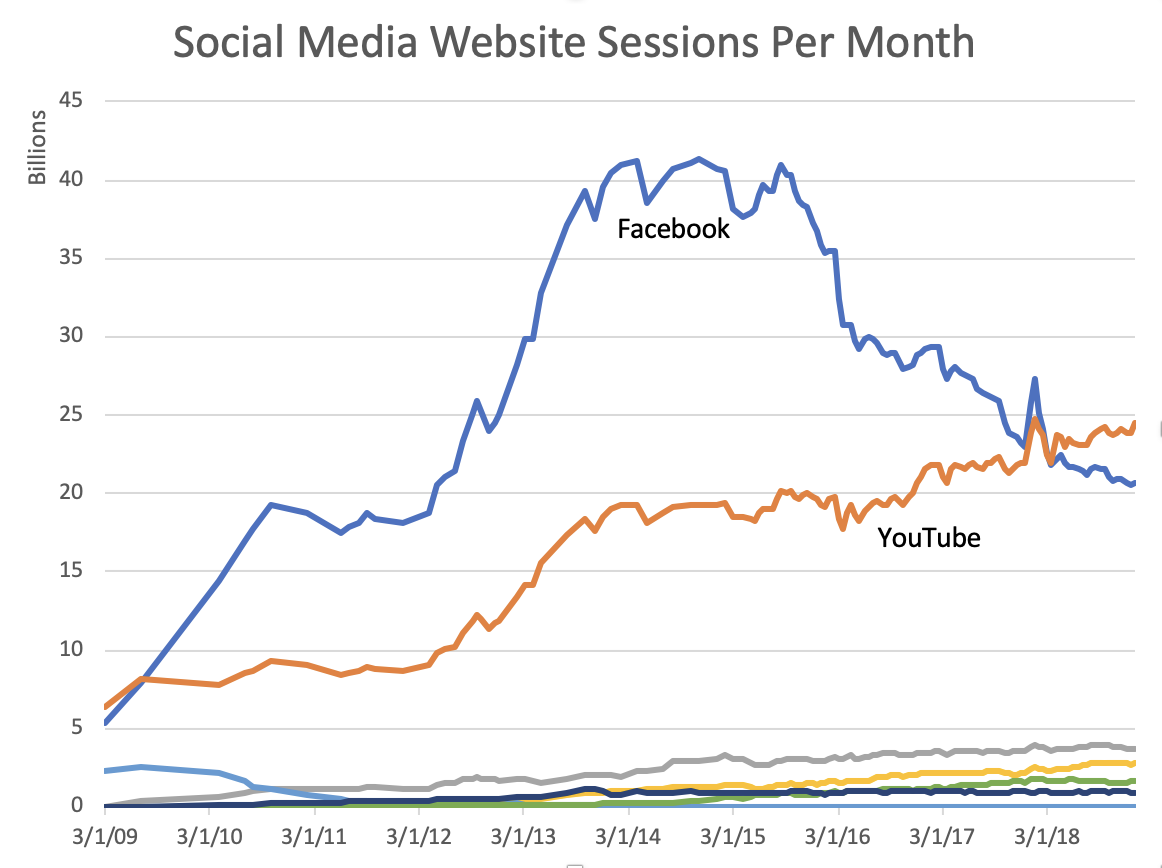
Facebook is out. Instagram and Snapchat are in. Or so it seems from the current communication patterns in my family recently. Social media might be a technological fad, but it does point out an underlying truth:  it is tough to keep up with technology. It seems to come and go, as if it is a fashion trend. Consider the change in fortunes for some of the top social media technologies in the past decade. I built the following chart using website traffic data from rank2traffic.com.  One of the earliest social media sites, Myspace, peaked in 2009, but has steadily declined since then while others that started around then have grown substantially.


Social Media Website Sessions Per Month
In order to see these trends, I had to leave out the two largest brands: Facebook and YouTube. They are an order of magnitude more popular. One might quibble about whether YouTube counts as social media, since it focuses more on video than on text communication, but these categories blur, as Facebook also has considerable visual content (including images and video), and others are focused on images as well, such as Instagram, Snapchat, and Pinterest.


Social Media Website Sessions Per Month


Another nuance here that perhaps only an engineer could love is that this only shows website traffic, which may be unfair to platforms that have focused on mobile devices, such as twitter.  The number of tweets sent via the twitter website is likely eclipsed by the number sent within the twitter app. Similarly, the decline in Facebook traffic after 2016 may not be as pronounced as this data implies, as much of the traffic may have shifted to the Facebook app on mobile devices.


Even engineers like me find it difficult to stay current with the flood of new gadgets, exotic engineered materials, new software apps, advances in medicine, advances in computing, and more. As technology improves and grows, our scientific understanding of the world deepens. As technology matures and expands, our ability to control our environment increases. Yet, for all that technological control we have gained, why do we individually so often feel rather out of control? Perhaps it is our natural reaction to change.


Painting attributed to Hieronymus Bosch, The Seven Deadly Sins and the Four Last ThingsWe change our world and ourselves with technology, yet human nature remains the same. We remain God’s creatures made in his own image, created good. God created us male and female, in community and relationship. Even genetic engineering does not change our human need to connect. God created us with an innate ability to recognize the divine and a special gift to worship our Creator. Even precise descriptions of subatomic quantum effects do not change our human intuition that there is something more to life than that which meets the eye. God made us the pinnacle of his creation with delegated authority and responsibility to care for the world. Even the independence we attain through technology (such as personal transportation like the automobile or personal communication like smartphones) does not change our mandate to be stewards of creation, as representatives and in service to the Creator. In fact, our role as stewards gets at the root of our ability to create technology. It is not surprising that God created humans with innate ability to make tools. We are homo faber, man the tool maker. As stewards, we have the unique ability to value the creation, to recognize the embedded worth of the resources around us as a gift.  We unwrap the gift by cultivating and developing the creation with sensitive care. Our tool-making ability suits us well for these tasks.


We change our world and ourselves with technology, yet human nature remains the same. We remain fallen, tainted by sin so that we are inclined to hate God and each other. We remain in need of redemption by the blood of the Lamb. While we humans have produced many new technologies, we have not invented any new means of salvation nor have we invented any new sins. I suggest that every human foible and failing that appears novel the first time we see it depicted in the latest video or read about it in our newsfeeds it is not new at all.  It is really the same news about sin, the same old wolf dressed up in new sheep’s clothing. Creative humans continually develop new tools, and fallen humans continually pursue old sins with the latest tools. There is nothing new under the sun, in a spiritual sense.


However, I do not want to minimize the danger of new tools in our fallen hands. Even if the sin is old hat, technology is an amplifier. The impact of a sin can be far greater when we use tools.
Technological amplification of sin can be the result of unintentional mistakes due to our finite nature. For example, the primary design purpose of a hammer is not bodily injury (though your thumb may disagree). Nevertheless, a hammer in the hands of an angry sinner amplifies their power to injure. Technological amplification of sin can also be the result of malicious acts due to our fallen nature. For example, the primary design purpose of a switchblade is bodily injury.  This weapon in the hands of an angry sinner greatly increases their ability to draw blood.


As Christians, how can we improve our discernment, remaining wary of technological amplification of sin? For Christians working in technical areas, we have an even greater responsibility to prophetically point out these effects and when possible, to direct our tech designs towards minimizing sinful abuse. One strategy to redeem your personal use of modern technology is to keep in mind the ancient list of the seven deadly sins, identified since Medieval times:

Lord willing, in future blogs I hope to dive into further details on each of these vices, exploring how technology can be the new sheep’s clothing that dresses up that old wolf of sin.